Fabric & Quality
What Is Combed Compact Cotton? The Fabric Detail You Can Actually Feel
You probably know cotton. But what happens before cotton becomes a T-shirt?
When you buy a cotton T-shirt, you’re usually thinking about the fabric.
But before that fabric ever reaches your skin, cotton has already gone through several stages of preparation. The fibres have to be cleaned, aligned, refined and eventually spun into yarn. That yarn is then knitted into the fabric that becomes your T-shirt.
And this is where the phrase “combed compact cotton” becomes interesting.
It sounds like one complicated material specification. It actually describes two different things happening to cotton before it becomes fabric: combing and compact spinning.
Neither process changes cotton into a different natural fibre. They refine how the fibres are prepared and how they are brought together into yarn.
And that matters because the quality of a T-shirt doesn't begin when the garment is stitched.
It begins much earlier — at the fibre and yarn level.
So, what exactly is combed cotton?
Combed cotton is cotton that goes through an additional mechanical combing stage after the initial carding process.
Carding helps separate, clean and roughly align the fibres. Combing takes that preparation further by using fine combs to remove shorter fibres, neps and remaining impurities while aligning the longer fibres more consistently.
Think of it like refining a group of fibres before asking them to become yarn.
The shorter and less useful fibres are separated out, while the more suitable fibres are aligned and prepared for spinning.
The result can be a cleaner and more uniform yarn with lower hairiness and a smoother surface than comparable carded yarns. Combing also adds processing cost because it requires an additional manufacturing stage and removes some fibre in the process.
This is one reason combed cotton is commonly associated with more refined apparel.
But there is another part of the story.
What does “compact” mean?
This is where many product descriptions become confusing.
Compact does not mean that the cotton itself is a special species of cotton.
It refers to the spinning technology used to turn fibres into yarn.
In conventional ring spinning, fibres form a region known as the spinning triangle before twist is inserted. Compact spinning adds a fibre-condensing stage that brings the fibres closer together before the yarn is formed. This can reduce hairiness and improve fibre integration within the yarn.
In simple terms, the fibres are controlled more closely before they become yarn.
That can produce a yarn with a smoother surface and improved structural characteristics compared with conventional ring-spun yarn under comparable conditions. Research on compact spinning has specifically identified reduced hairiness and improved mechanical properties as important characteristics, although the exact result depends on the fibre and manufacturing conditions.
So when you see “compact cotton,” you are looking at a spinning method.
When you see “combed cotton,” you are looking at a fibre-preparation method.
When you see “combed compact cotton,” you're seeing both.
Combed + compact: why combine the two?
This is where the specification becomes more meaningful.
Combing refines the fibre population before spinning.
Compact spinning improves fibre control during the spinning process.
Together, they can produce a cleaner, more controlled yarn with lower hairiness and a smoother surface than less-refined yarn constructions, assuming comparable raw materials and appropriate processing.
That difference may not sound dramatic on a specification sheet.
But yarn is the foundation of knitted fabric.
And when you wear a T-shirt, you aren't really experiencing “cotton” as an abstract material. You're experiencing the result of the fibre, yarn, knitting, finishing and garment construction working together.
That is why two T-shirts can both say 100% cotton and still feel completely different.
Why does combed compact cotton feel different?
The easiest way to understand it is to stop thinking about the label and think about the surface.
A yarn with fewer protruding fibres can create a cleaner, smoother surface. Compact spinning is specifically associated with reduced yarn hairiness, while combing removes shorter fibres and improves fibre alignment before spinning.
That can contribute to the refined hand feel people often associate with premium cotton garments.
It can also help create a cleaner-looking fabric surface.
But this is important:
Combed compact cotton does not automatically make every T-shirt premium.
The starting cotton still matters. Yarn count matters. Twist matters. Knitting construction matters. Finishing matters. Garment construction matters.
The word “compact” cannot compensate for poor raw material or poor manufacturing.
Is combed cotton better than regular cotton?
Not necessarily in every situation.
It is more accurate to say that combing is an additional refinement process.
Compared with carded cotton from comparable raw material and construction, combed yarn generally offers a cleaner fibre profile and lower hairiness, and it is often selected for garments where smoothness and consistency matter.
But cotton quality exists on a spectrum.
A well-made garment depends on more than whether the label says “combed.”
You still need to consider the quality of the underlying cotton, yarn specification, fabric construction and finishing.
This is why a serious clothing brand shouldn't use one technical word as a shortcut for quality.
What is the difference between combed cotton and compact cotton?
The simplest explanation is this:
Combed cotton = how the fibres are prepared.
Compact cotton = how the fibres are spun into yarn.
Combed compact cotton = both processes are used.
A cotton yarn can be compact without being combed. It can also be combed and then spun using conventional ring spinning. These are separate specifications, which is why a complete yarn description matters more than simply seeing the word “compact” on a product page.
This distinction is often lost in fashion marketing.
And it shouldn't be.
Because understanding the process helps you understand what you're actually buying.
Does combed compact cotton prevent pilling?
It can help, but it would be wrong to say that it makes a T-shirt completely pill-proof.
Pilling depends on several factors, including fibre characteristics, yarn construction, fabric construction, finishing, friction and laundering.
Removing shorter fibres during combing and reducing yarn hairiness through compact spinning can contribute to a cleaner yarn structure, which is one reason these constructions are often associated with reduced pilling potential.
But no responsible specification should promise that a cotton T-shirt will never pill.
The entire garment matters.
Why does this matter for an oversized T-shirt?
An oversized T-shirt depends heavily on how the fabric behaves.
The same oversized pattern can look completely different depending on the fabric underneath it.
A lightweight, highly fluid fabric can create a softer and more relaxed silhouette. A more substantial fabric can provide additional body and structure.
But fabric weight alone isn't responsible for the final appearance.
The yarn, knitting construction and finishing all contribute to how the fabric feels and falls.
This is why GSM and yarn quality should be considered together, rather than treating GSM as a standalone quality score.
A 240 GSM T-shirt made from a well-specified yarn can feel completely different from another 240 GSM T-shirt made using a different yarn and construction.
The number is only part of the story.
Why VELVETO uses combed compact cotton
At VELVETO, the objective isn't to make a T-shirt sound premium on a specification sheet.
The objective is to make the garment feel considered when you actually wear it.
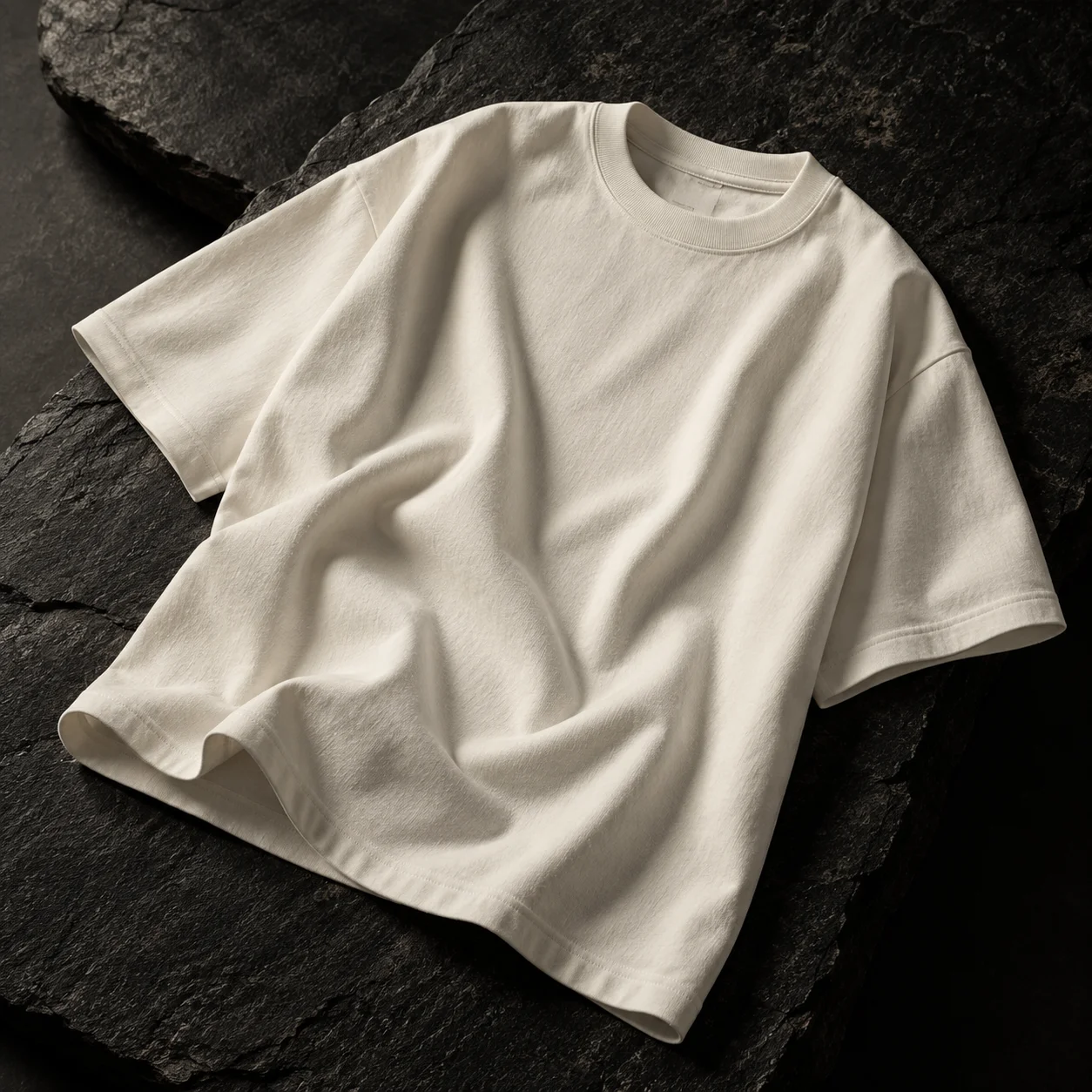
Our 240 GSM oversized T-shirt uses 100% combed compact cotton, combined with a double bio-wash and super-soft silicone finish.
The choice is deliberate.
The yarn specification is part of the foundation. The 240 GSM weight gives the fabric substantial body for the intended oversized silhouette. The finishing is then used to influence the final hand feel.
None of these details works independently.
The goal is the combination.
Fibre. Yarn. Fabric. Finish. Fit. Construction.
That is what makes a garment feel different.
So, is combed compact cotton worth it?
If you're buying a T-shirt simply because the label says “cotton,” the difference may not be obvious from the product description alone.
But if you're trying to understand why two apparently similar cotton T-shirts can feel different, the yarn stage is worth paying attention to.
Combing refines the fibres. Compact spinning improves fibre control during yarn formation. The resulting yarn can provide a smoother, cleaner foundation for knitted fabric. And that foundation eventually becomes the T-shirt you put on.
So the next time you see “100% cotton,” don't stop there.
Ask what kind of cotton.
Ask how the fibres were prepared.
Ask how the yarn was spun.
Ask how the fabric was finished.
Because premium isn't created by one impressive word on a product page.
It is built through the details you can feel.
And that is the difference VELVETO is trying to make.
Luxury should be felt, not announced.