Style & Culture
What Is the Old Money Aesthetic? A No-BS Guide for Guys Who Actually Want to Dress Like It
What the Old Money Aesthetic Actually Means
The phrase “old money aesthetic” describes a fashion style built around the visual language traditionally associated with established wealth: understated clothing, classic silhouettes, muted colours, polished details and very little obvious branding. On social media, the term has become much broader than its original cultural associations. Today, it is often used to describe a particular way of dressing that feels timeless, composed and deliberately understated.
That distinction matters. Dressing in an old money aesthetic does not mean you are claiming to come from generational wealth. It is a visual style, not a financial background. You can adopt its principles without adopting the fantasy attached to the name.
The simplest way to understand it is this: the outfit should look considered without looking desperate for attention.
Why Everyone Keeps Calling It Old Money
Fashion has always moved between understatement and display. The current popularity of old money and quiet luxury is partly a reaction to years of visible logos, hype-driven releases and highly recognisable branding. Instead of asking people to notice the brand first, understated dressing asks them to notice the entire outfit.
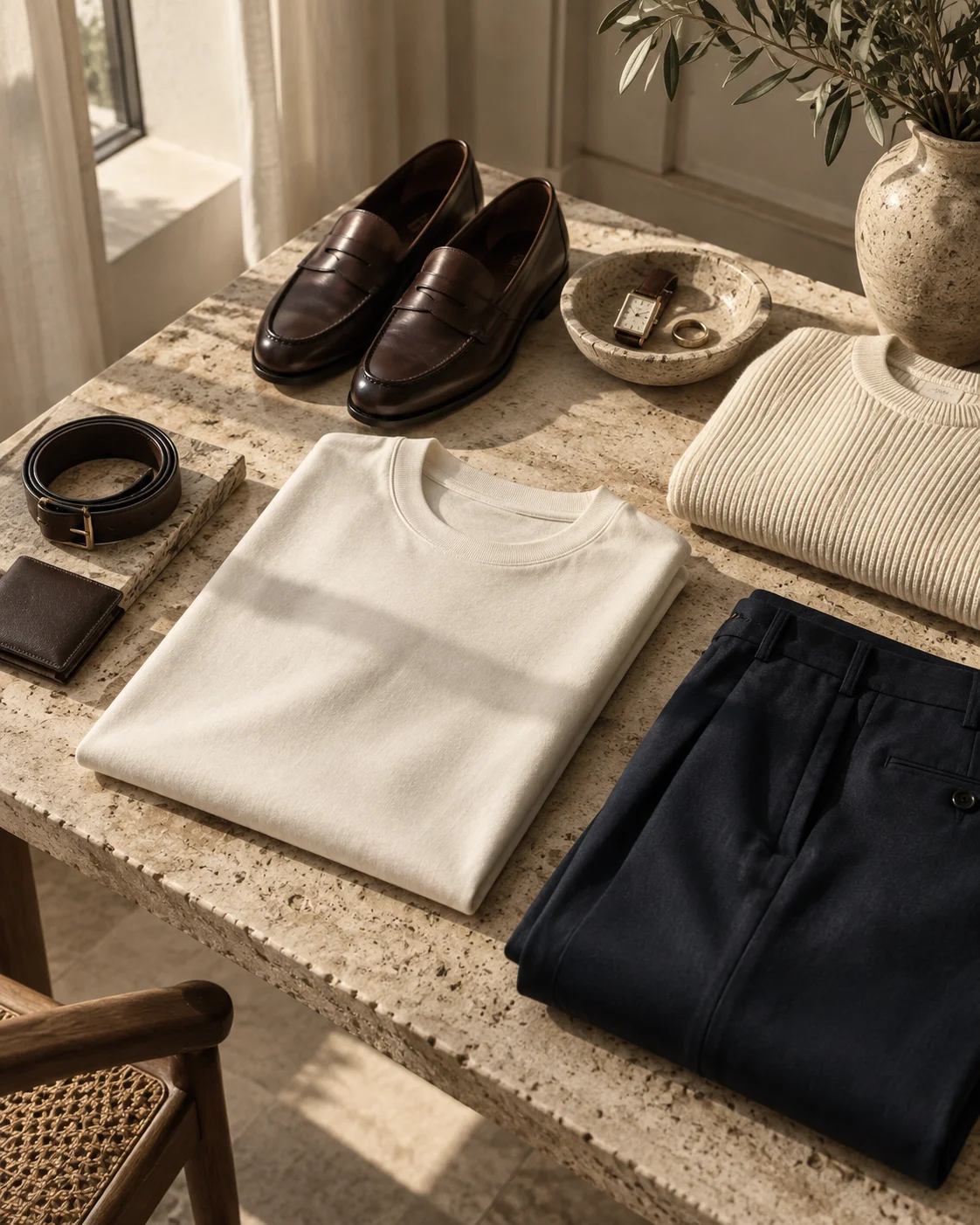
That is why the aesthetic has become particularly visible online. A cream knit, navy trousers, leather loafers and a simple watch can communicate a very different visual message from a logo-heavy outfit even when both outfits cost very different amounts.
The important part is that the aesthetic is not actually dependent on a huge budget. The principles are accessible even when the garments are not.
The Real Foundation Is Fit
If there is one thing that separates convincing old money-inspired dressing from costume dressing, it is proportion.
A shirt that is too tight immediately changes the character of an outfit. Trousers that pool excessively at the shoe can make an otherwise refined look feel careless. A jacket with the wrong shoulder width can make the entire silhouette look borrowed.
The goal is not necessarily slim clothing. Modern versions of the aesthetic can work with relaxed, straight and slightly oversized proportions. What matters is that the silhouette looks intentional.
This is particularly important with casual pieces such as T-shirts. A premium T-shirt does not need to be skin-tight to look refined. A structured fabric, controlled drape, clean neckline and deliberate silhouette can make a simple T-shirt feel considerably more elevated than its basic construction suggests.
Colour Does More Than the Logo
The old money aesthetic is strongly associated with colours that do not fight for attention. Navy, cream, ivory, white, stone, beige, brown, charcoal, olive and muted blue naturally create combinations that feel cohesive.
That does not mean every outfit needs to be completely beige.
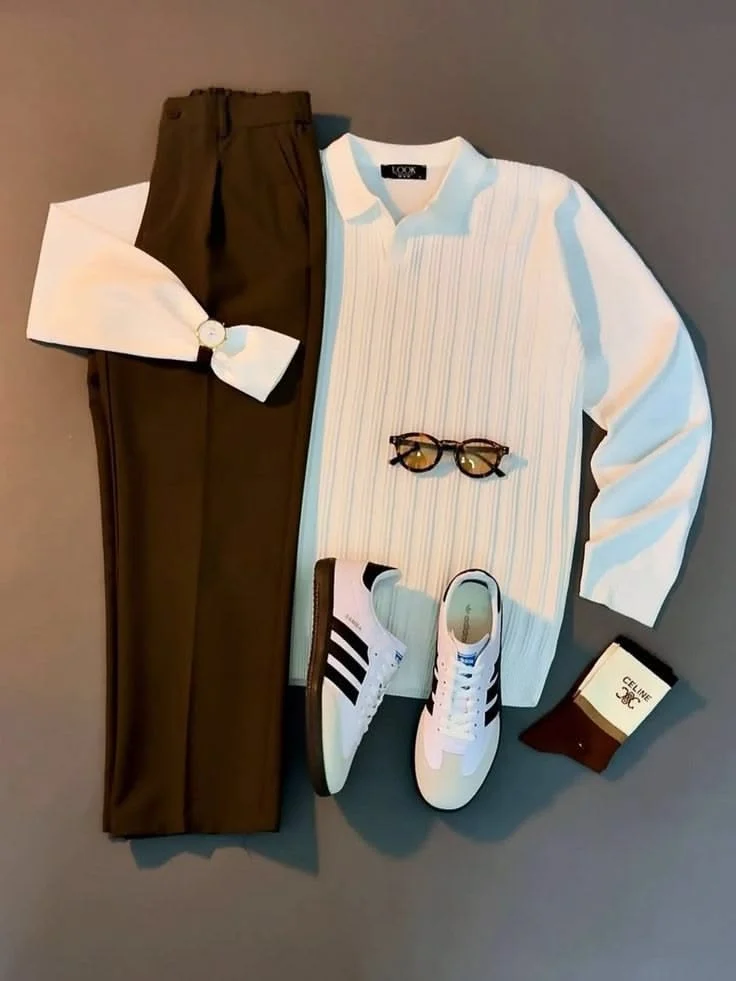
The mistake is treating neutral colours as a uniform. The more interesting approach is to create contrast through temperature, texture and depth. An ivory T-shirt with dark brown trousers can feel richer than an outfit consisting entirely of pale neutrals. Navy with cream works because the contrast is clean. Charcoal with white creates a sharper interpretation of the same principle.
Colour should make the outfit look intentional, not make the wearer look like they followed a colour chart.
Fabric Is Where the Aesthetic Becomes Visible
A photograph can make almost any garment look expensive. In real life, fabric exposes the difference.
The way a garment falls, how the surface catches light, how the neckline holds its shape and how the fabric behaves after repeated washing all influence how premium it feels.
This is one reason natural fibres and well-developed fabric constructions appear so frequently in discussions around quiet luxury. Cotton, linen, wool and other quality materials can create texture and drape that contribute to the overall impression of an outfit.
But fabric composition alone is not a guarantee of quality. A T-shirt labelled with an impressive fibre name can still have poor construction, weak finishing or an unflattering silhouette. The material, construction and fit need to work together.
Logos Are Not the Point
One of the biggest misunderstandings surrounding old money style is the belief that removing a logo automatically makes something luxurious.
It does not.
A badly fitted blank T-shirt without a logo is still a badly fitted T-shirt.
The reason understated wardrobes often contain little visible branding is that the garment itself becomes the focus. Construction, proportion, colour and material have to carry the visual weight.
This is also where the aesthetic overlaps with quiet luxury, although the terms are not perfectly interchangeable. Quiet luxury generally refers to understated luxury and subtle signalling, while stealth wealth is more specifically associated with concealing or minimising visible signals of wealth. The terminology is often blurred online, but the common visual language is restraint.
The Difference Between Looking Refined and Looking Like You Are Trying to Look Rich
This is where most “old money” outfits go wrong.
When every element is deliberately designed to communicate wealth, the outfit can become more theatrical than sophisticated. The loafers are too shiny. The shirt is too open. The trousers are excessively pleated. The sunglasses are oversized. The watch is conspicuous. Everything is beige.
Individually, none of these choices is necessarily wrong. Together, they can make the outfit look like a costume built around an internet trend.
The stronger approach is subtraction.
One refined piece does not need five other pieces announcing that it is refined. A good pair of trousers can sit beside a simple T-shirt. A structured jacket can be worn with ordinary denim. A textured knit can carry an otherwise simple outfit.
The outfit should feel like a wardrobe, not a character.
You Do Not Need to Dress Formally
Another misconception is that old money style means blazers, loafers, polo shirts and tailored trousers every day.
That is only one interpretation.
The modern aesthetic can be casual. A clean T-shirt, straight trousers and understated sneakers can belong to the same visual world when the proportions, colours and materials are controlled.
This is particularly useful for younger men because it makes the aesthetic wearable rather than theatrical. You do not have to dress like you are attending a country club to borrow the principles behind the style.
The objective is refinement without unnecessary formality.
The T-Shirt Can Actually Be Part of the Look
The T-shirt is often treated as the opposite of luxury because it is one of the simplest garments in a wardrobe. In reality, simplicity is exactly what makes it useful.
A well-designed T-shirt can become the foundation of a quiet wardrobe when the silhouette is intentional and the fabric has enough structure to hold its shape.
This is where details that are almost invisible from a distance become important. Shoulder construction, neckline stability, fabric density, finishing and drape can determine whether the garment looks ordinary or considered.
A restrained T-shirt also gives the rest of the outfit room to work. It does not compete with trousers, outerwear, jewellery, footwear or texture.
For a modern wardrobe, that versatility is arguably more valuable than a garment that exists only to communicate a particular trend.
The Biggest Old Money Mistake Is Buying the Aesthetic Instead of Understanding It
You can spend a significant amount of money and still completely miss the point.
Buying an expensive polo because a social media video labelled it “old money” does not automatically create an old money wardrobe. Neither does purchasing a beige overshirt, loafers and a gold watch and wearing all three together.
The aesthetic works because the individual choices make sense together.
A good wardrobe should give you combinations rather than costumes. The same T-shirt should work with trousers, denim, shorts and layered pieces. The same neutral overshirt should work across different outfits. The same pair of shoes should not look out of place outside one carefully constructed photograph.
That is the difference between collecting aesthetic objects and actually developing personal style.
Old Money Is Not the Same as Looking Boring
Minimal does not have to mean lifeless.
Texture can create interest without graphics. Proportion can create interest without logos. A slightly unusual shade can create interest without becoming loud. Jewellery, footwear and fabric can introduce personality while keeping the overall outfit restrained.
This is why the best examples of understated dressing often look simple at first glance but become more interesting the longer you look at them.
There is no requirement to remove personality from an outfit. The objective is to control it.
The Modern Version Is More Relaxed
The social-media version of old money style has changed considerably from traditional formal menswear. Contemporary interpretations often combine relaxed silhouettes with classic colours and understated materials.
That means a boxier T-shirt, relaxed trousers or slightly oversized knitwear can work perfectly well within the broader aesthetic.
The key is balance.
If the top is oversized, the trousers do not necessarily need to be extremely wide. If the trousers are relaxed, a more structured top can create balance. If everything is loose, the outfit needs another form of structure through fabric, footwear or proportion.
The aesthetic is therefore less about copying a fixed uniform and more about understanding visual balance.
How to Build the Look Without Becoming a Walking Pinterest Board
Start with clothes you would genuinely wear.
A small collection of well-chosen T-shirts, trousers, knitwear, shirts, outerwear and footwear can create far more combinations than a wardrobe full of trend-specific pieces.
Keep the colour palette compatible. Pay attention to proportions. Choose fabrics that feel good and hold their shape. Avoid buying something simply because someone online called it “old money.”
Most importantly, stop thinking about whether an outfit looks expensive.
Think about whether it looks intentional.
That shift changes everything.
The No-BS Definition
If you remove the TikTok edits, yacht photographs, fake generational-wealth narratives and endless beige outfits, the old money aesthetic becomes much easier to understand.
It is a modern fashion language built around restraint.
Classic rather than disposable. Understated rather than logo-heavy. Refined rather than overstyled. Quality-conscious rather than obsessed with price.
You do not need to be born into wealth to dress this way, and you do not need to pretend that you were.
The strongest version of the aesthetic is simply a wardrobe where the clothes look good because they are well chosen, well proportioned and quietly confident.
That is the part worth keeping.